
Learning And Growth
Sixth (Age 16-18)

What subjects can my child study in Sixth Form?

Cranleigh Sixth Form students choose from a broad mix of exam courses – sciences and maths, humanities, languages and the creative arts – giving them the freedom to follow what excites them most. Pupils typically take three A-levels or BTECs, then add something extra such as an EPQ (Extended Project Qualification), Core Maths, the Music Diploma or Personal Training Diploma to stretch themselves and feel ready for life after school.

What A-level options does Cranleigh Sixth Form offer?

A-level choices at our Sixth Form in Surrey give pupils plenty of scope to follow subjects that spark interest and support future aspirations.

  • Sciences & Maths: Biology, Chemistry, Physics, Mathematics, Further Mathematics, IT: Data Analytics, Sport Science
  • Humanities & Languages: History, Geography, Politics, Economics, Psychology, Philosophy of Religion, Classical Civilisation, English, French, Spanish, Latin, Business (A-level + BTEC)
  • Arts & Creative: Art, Drama, Music, Design Engineering, Product Design
  • Sports: Physical Education, Sports Science, Sport BTEC

What core electives does Cranleigh Sixth Form offer?

Pupils can add one of the following to enrich their A-level programme:

  • EPQ (Extended Project Qualification)
  • Core Maths
  • Music Diploma
  • Personal Training Level 3 Diploma

These electives deepen skills, build independence and prepare pupils for university-style learning.

Where do Cranleigh Sixth Formers go to university?

Cranleigh Sixth Form is where everything comes together – the culmination of their school journey and the point at which they step out ready for university and the wider world. Many go on to Russell Group universities, Oxbridge, US colleges, conservatoires and a wide range of creative and specialist pathways. It’s a mix that shows how individual their journeys are, and how well a Cranleigh education prepares pupils for what comes next.

What is the EPQ at Cranleigh Sixth Form?

The Extended Project Qualification (EPQ) is a research-based qualification that pupils take alongside their A-levels. It’s part of Cranleigh’s Core Electives programme – a Sixth Form enrichment pathway that gives students the chance to explore something they genuinely care about completely independently.

It’s brilliant preparation for university-style study as pupils learn how to manage a long project, carry out academic research and stay organised from start to finish. The EPQ is worth half an A-level and carries UCAS points, which can help with university offers.

Pupils can shape their project in different ways: a dissertation, a performance or an artefact – whatever suits them best.

Find out more about EPQ
Sixth Form Learning Support Summer 2026

What learning support is available in Sixth Form?

Cranleigh makes sure every pupil who needs it gets specialist support with study skills, exam access arrangements and university applications. The support is discreet, expert and tailored, giving pupils calm, steady guidance as they move through Sixth Form.

Sixth Form Futures Summer 2026 1

How does Cranleigh build innovation in Sixth Form?

Innovation runs right through Sixth Form. It starts with discussion-led teaching and the Advanced Diploma, where pupils build skills in critical thinking, ethics, finance and media to help them question, analyse and think in new ways.

The Cranleigh Futures programme adds a real-world edge. Pupils get involved in industry webinars, Futures Day, university roadshows, public-speaking training, interview preparation, CV and LinkedIn support, plus relaxed careers-and-croissants events. They explore apprenticeships, graduate apprenticeships, gap years, entrepreneurship and wider pathways, encouraging them to think creatively and approach their future with confidence.

Frequently asked questions about Sixth (age 16-18)

How many A-levels do pupils typically take?

Most pupils study three A-levels alongside the EPQ, with a small number choosing four. You can explore typical A-level combinations in our Sixth Form Options guide.

What A-level results do pupils get at Cranleigh?

Cranleigh pupils achieve consistently strong A-level results. In 2025, 50% of grades were A*–A and 83% were A*–B, with a 100% pass rate. Pupils go on to a wide range of leading universities, degree apprenticeships and other destinations.

When do applications open?

At the start of the Lent term of Year 10 for September entry. On average, about 30 pupils join each academic year. Find out more about the Sixth form admissions process below.

Do you take external 16+ (Year 12) pupils?

Yes – and we warmly welcome them into the Cranleigh School community. Our strong pastoral care and lively House life mean newcomers quickly feel at home.

What's the Sixth Form class size?

Sixth Form class sizes vary but the average is around 10-14 students.

Is there a Sixth Form House?

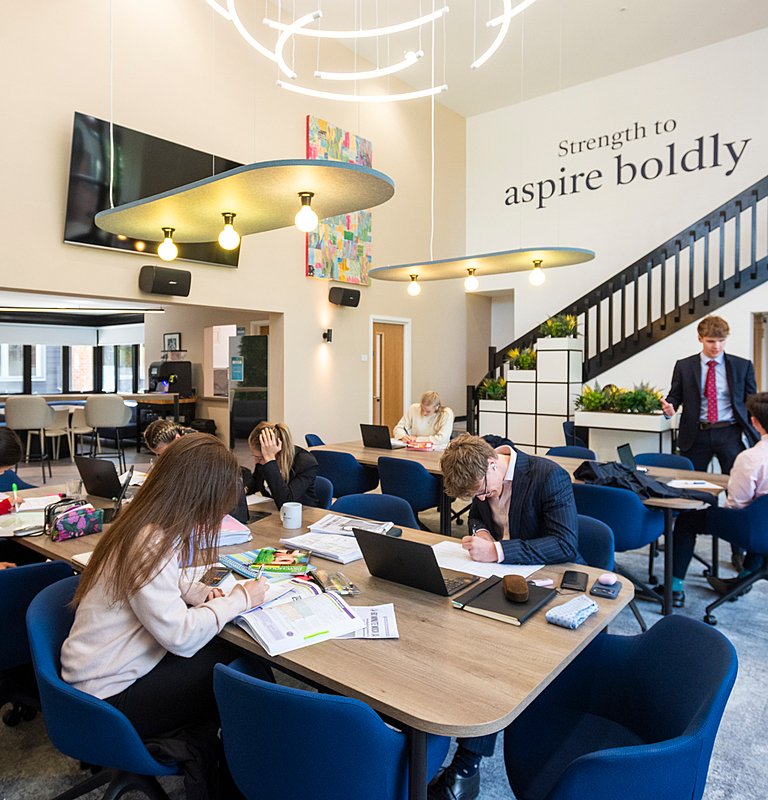
Sixth Formers join one of the eight existing houses, and also have a newly refurbished Sixth Form Centre which has study areas, a cafe and social space.